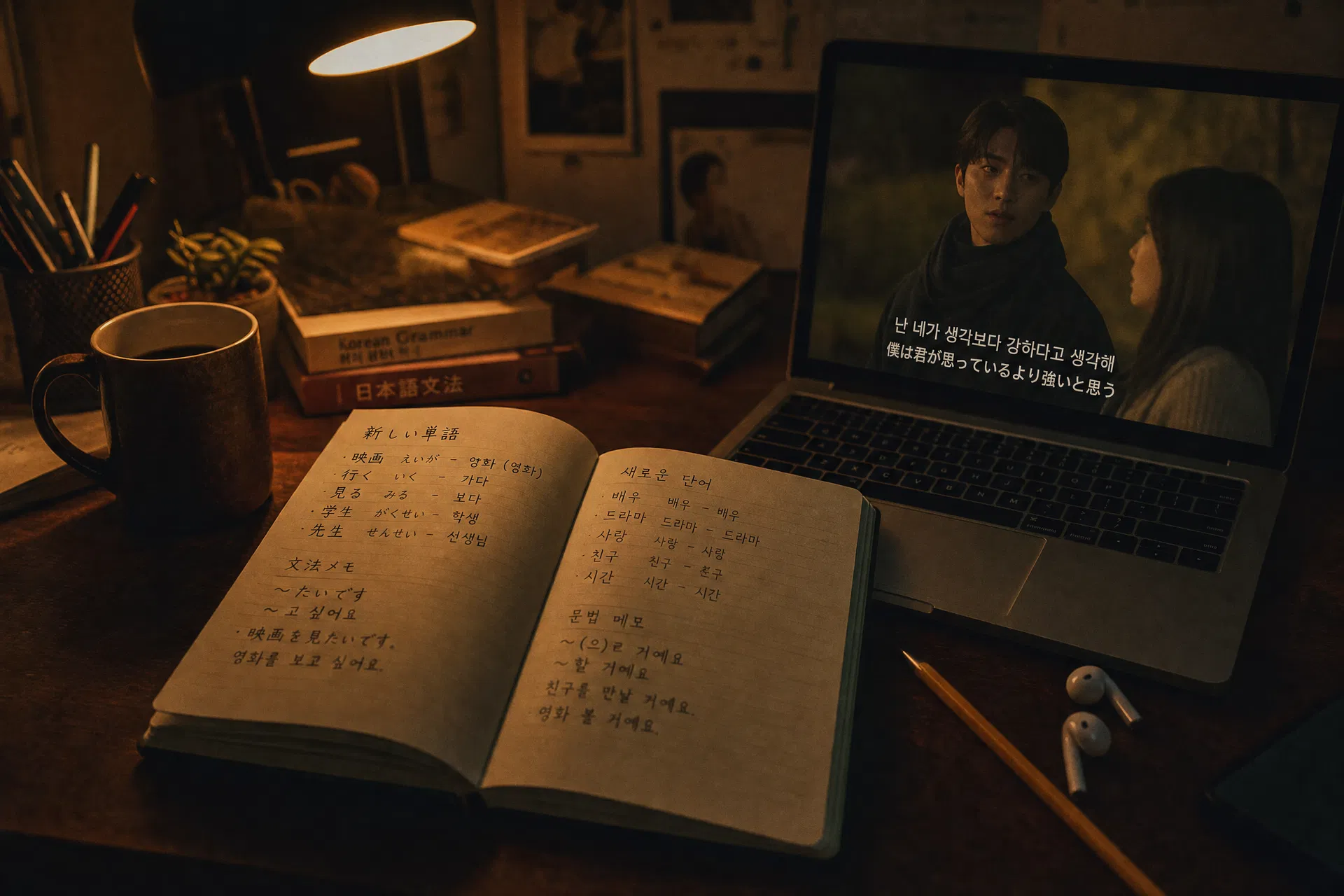
Sentence Mining from Streaming: The Complete Method
How to extract, review, and retain vocabulary from shows you actually enjoy watching — the most effective vocabulary acquisition method for intermediate learners.
What Is Sentence Mining?
Sentence mining is the practice of extracting example sentences from authentic content — streaming shows, YouTube videos, podcasts, books — and converting them into spaced-repetition flashcards. Instead of memorizing vocabulary from a word list, you encounter words in the context of real sentences you have heard from native speakers.
The research on this is clear: contextual learning produces significantly better retention than decontextualised vocabulary study. When you hear a word in a scene you remember, the memory is richer and more durable than a word you read in a list.
Why Streaming Is the Best Source
Streaming platforms give you access to thousands of hours of native-speaker content across every genre, register, and dialect. A Korean drama exposes you to natural conversational Korean. A Spanish news broadcast exposes you to formal register. An anime exposes you to informal speech patterns you will not find in a textbook.
Crucially, streaming content is engaging. You watch because you want to know what happens next. This motivation sustains the habit over months and years — which is what language acquisition actually requires.
The Core Workflow
1. Choose the Right Content
The most effective content for sentence mining is material you can understand at roughly 70-80%. You should be able to follow the story even if you miss individual words. If you understand less than 50%, the cognitive load is too high for effective mining. If you understand 95%+, you are not encountering enough new vocabulary.
See our curated show recommendations by language for suggestions at different proficiency levels.
2. Set Up Your Tools
You need three things:
- A subtitle tool: LangPanda is the easiest option for most learners. It works on Netflix, YouTube, Disney+, and 20+ video sites.
- Anki: The free spaced-repetition app that schedules your reviews based on how well you know each card.
- AnkiConnect: A free Anki add-on that lets LangPanda send cards directly to your decks.
For a step-by-step setup guide, see how to export Netflix subtitles to Anki.
3. Watch and Mine
Watch your show with dual subtitles enabled. When you encounter a word or sentence you want to learn, click the export button. LangPanda sends the sentence — with the target language text, translation, and audio clip — directly to your Anki deck.
Be selective. Export sentences where you understand the context but one or two words are new. These are the sentences that will stick. Avoid exporting sentences where you understand nothing — the card will be too hard to review effectively.
4. Review Daily in Anki
Open Anki every day and review your due cards. Anki's algorithm will show you cards at the optimal interval — just before you would forget them. A 15-minute daily review session is more effective than a 2-hour session once a week.
Do not create more cards than you can review. Most learners find 10-20 new cards per day sustainable. If your review pile grows faster than you can clear it, reduce your mining rate.
Advanced Techniques
Sentence Cards vs. Vocabulary Cards
Always prefer sentence cards over isolated vocabulary cards. A sentence card shows the full subtitle line on the front and the translation on the back. This preserves the audio and visual context that makes the word memorable. Vocabulary-only cards ("word → translation") are less effective and harder to recall in real conversation.
The i+1 Principle
Linguist Stephen Krashen's concept of "comprehensible input" suggests that the most effective learning happens when input is just slightly above your current level — what he calls "i+1." In practice, this means choosing sentences where you understand everything except one or two words. If a sentence has five unknown words, it is too hard to mine effectively.
Shadowing
For speaking practice, combine sentence mining with shadowing. After reviewing a card in Anki, replay the audio and try to repeat the sentence at the same speed and intonation as the native speaker. This builds pronunciation and prosody alongside vocabulary.
How Many Cards Do You Need?
Research on vocabulary acquisition suggests that knowing the 3,000 most frequent words in a language gives you access to roughly 90% of everyday speech. Knowing 10,000 words gives you near-native comprehension. At 10-20 new cards per day, you can reach 3,000 words in 5-8 months of consistent study.
The key word is "consistent." Sentence mining works through accumulated daily effort, not through intense short-term bursts.
Frequently Asked Questions
LangPanda
The easiest way to sentence mine from Netflix, YouTube, and 20+ video sites. 1-click Anki export included.
Try Free (7 days)