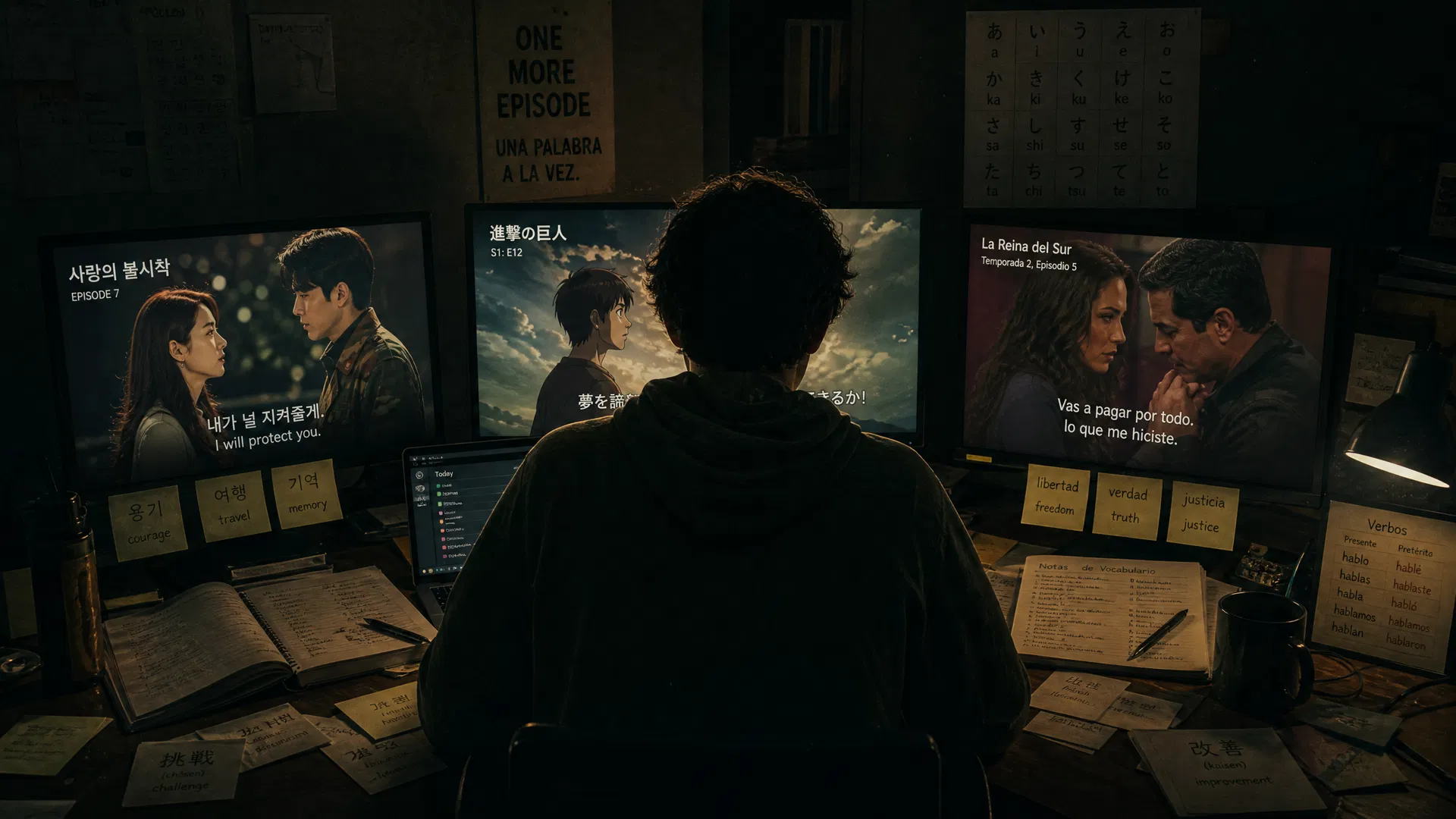
What is comprehensible input?
Comprehensible input is language you can mostly understand — typically 80–95% — with the remaining portion just beyond your current level. Linguist Stephen Krashen formalized this concept in the 1980s as the Input Hypothesis: language acquisition happens subconsciously when learners are exposed to meaningful input at what he called i+1.
The notation is elegant: i represents your current competence level, and +1 represents the next step up. Input at i+1 is challenging enough to drive acquisition but comprehensible enough that meaning can be inferred from context, prior knowledge, and situational cues — without translating every word.
"We acquire language in only one way — when we understand messages in the target language, when we understand what people say to us, not when we study grammar rules."
— Stephen Krashen, The Input Hypothesis (1985)
Why streaming is the ideal delivery mechanism
Authentic media — TV shows, films, YouTube — delivers comprehensible input in its most natural form: embedded in real cultural context, with prosody, emotion, and visual cues that aid comprehension. Unlike textbooks, streaming content is:
- ▸Infinitely varied — new vocabulary and grammar structures appear organically across thousands of hours of content
- ▸Emotionally engaging — emotional salience accelerates vocabulary retention (the 'emotional tagging' effect in memory research)
- ▸Culturally authentic — exposes learners to real register, slang, and pragmatic conventions that textbooks omit
- ▸Scalable to any level — from children's cartoons (A1) to political dramas (C1+)
Skip the manual subtitle lookup
LangPanda adds an instant pop-up dictionary to Netflix, YouTube, and Disney+ — look up any word without pausing, then export it to Anki in one click.
ⓘ Disclosure: BingeFluent earns a commission from links to our partners: LangPanda, Trancy, Lingopie, italki, and LingQ at no extra cost to you. We only recommend tools we believe in.
Try LangPanda FreeHow to calibrate your input level
The practical challenge is finding content at i+1 — not so easy that you're bored, not so hard that you're lost. A useful heuristic: if you need to pause and look up more than 15–20 words per episode, the content is likely too advanced for acquisition (though it may still be useful for extensive listening practice).
For reading-first input, LingQ is the platform implementation: it combines text/audio lessons and imported content with instant lookups and built-in vocabulary review across 40+ languages. Its free tier is a 20-saved-LingQ total demo, not an ongoing plan.
| Level | Content Type | Comprehension Target | Subtitle Strategy |
|---|---|---|---|
| A1–A2 | Children's shows, graded content | 60–70% | L1 subtitles as scaffold |
| B1 | Slice-of-life dramas, reality TV | 75–85% | L2 subtitles + pop-up dict |
| B2 | Crime dramas, comedy | 85–92% | L2 subtitles, minimal lookups |
| C1+ | News, documentaries, fast dialogue | 92–98% | No subtitles or L2 only |
Comprehensible input vs. output practice
Krashen's model is input-first: acquisition happens through comprehension, and output (speaking, writing) is a result of acquisition, not a cause. This is controversial — Merrill Swain's Output Hypothesis argues that production forces learners to notice gaps in their competence that input alone doesn't reveal.
The practical consensus among immersion practitioners: prioritize input heavily in the early stages (A1–B1), then introduce structured output (conversation practice, writing) once you have a solid receptive foundation. Trying to speak before you have sufficient input typically produces fossilized errors that are difficult to correct later.