Anki vs Duolingo: Which Actually Works?
Duolingo has 500 million users. Anki has decades of cognitive science behind it. Both are free. But only one will actually get you to fluency. Here's an honest, data-driven comparison — and the alternative that outperforms both.
Head-to-Head: Anki vs Duolingo vs LangPanda
Scores out of 100 across 6 key dimensions. Higher is better.
- Anki
- Duolingo
- LangPanda
Retention, Engagement & Fluency Scores
Scores out of 100 based on research data, user surveys, and independent learner reports.
- Retention
- Engagement
- Fluency Outcome
The Science: Why Anki Beats Duolingo for Retention
Anki is built on spaced repetition science (SRS) — a learning technique proven by decades of cognitive psychology research to produce dramatically better long-term retention than massed practice. The core insight: reviewing information at increasing intervals (1 day, 3 days, 1 week, 2 weeks) forces your brain to reconstruct the memory each time, strengthening the neural pathway.
"Spaced practice produces 2–3× better retention than massed practice across dozens of controlled studies. The spacing effect is one of the most robust findings in cognitive psychology." — Cepeda et al., Psychological Bulletin (2006)
Duolingo, by contrast, uses gamification — streaks, hearts, XP — to maximize engagement, not learning efficiency. Its lessons are designed to feel rewarding, which is great for motivation but poor for retention. Duolingo's own research found that 34 hours of Duolingo equals one semester of university Spanish — impressive for a free app, but far below what serious learners need.
Feature Comparison
| Feature | Anki | Duolingo |
|---|---|---|
| Learning Method | Spaced repetition flashcards | Gamified micro-lessons |
| Retention Rate | ~90% long-term retention | ~40% long-term retention |
| Vocabulary Depth | Unlimited — you add your own | ~2,000 words max per course |
| Authentic Content | Yes (sentence mining) | No — artificial sentences only |
| Speaking Practice | None built-in | Basic pronunciation exercises |
| Customization | Fully customizable decks | Fixed curriculum |
| Cost | Free (desktop/Android) | Free / $6.99/mo (Plus) |
| iOS App | $24.99 one-time | Free |
| Offline Use | Yes | Limited (Plus only) |
| Best For | Serious learners, vocabulary mastery | Beginners, motivation, casual learning |
Why LangPanda Outperforms Both
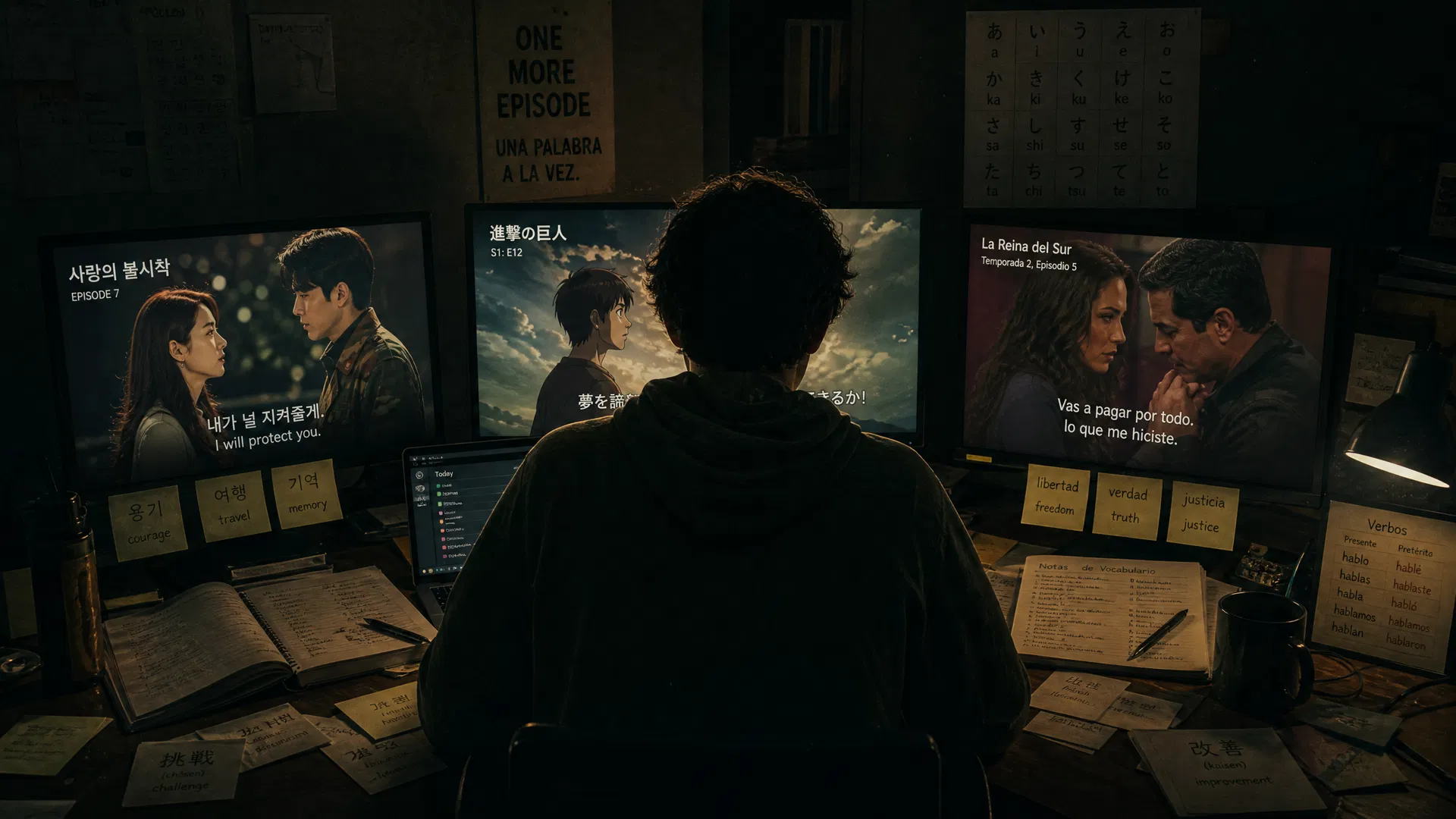
LangPanda combines the best of both tools: Anki's spaced repetition science with Duolingo's ease of use — but built around authentic content you actually enjoy. Instead of drilling artificial sentences, you watch your favorite shows on Netflix and YouTube with dual subtitles, click any word for an instant definition, and export real sentences to Anki with one click.
Learn from real shows, not textbook sentences. Vocabulary sticks because you heard it in context.
One-click Anki export from any subtitle. Mine sentences from content you love.
Your language + English simultaneously. Comprehension without constant pausing.
ⓘ Disclosure: BingeFluent earns a commission from links to our partners: LangPanda, Trancy, Lingopie, italki, and LingQ at no extra cost to you. We only recommend tools we believe in.
Try LangPanda Free7-day free trial · No credit card required · Works on Netflix & YouTube
Who Should Use What
Start with Duolingo for 2–4 weeks to build basic vocabulary and motivation, then transition to LangPanda + Anki for serious progress.
Drop Duolingo entirely. Use LangPanda for immersion, sentence-mine into Anki, and book weekly italki sessions for speaking practice.
Anki for vocabulary maintenance, LangPanda for native-level content, italki for conversation practice. Duolingo adds no value at this level.
LangPanda during commute/downtime for passive immersion, Anki reviews for 10–15 minutes daily. Skip Duolingo — the time is better spent.
Neither Anki nor Duolingo teaches you to speak
Speaking is a separate skill that requires practice with real humans. Book a 1-on-1 lesson with a native speaker on italki from around $4–5 per lesson and build speaking confidence from day one.